
"You," he said to one boy, "are Ibo." "You are Hausa," to another. Soon, it was my turn. I took my place in front of him. He studied me, then leaned forward and smiled.
"You," he said, "are Fulani."
We all giggled; these words sounded so strange to our young ears.
"Come," he said. I followed him over to a giant shelf. He retrieved a book, opened it, pointed to a picture of a girl. "There. You see?"
I stared at it. And wondered how a picture of ten-year old me somehow got in this book Ishtu's wise relative was now holding. It was the first moment I actually seemed to make the real connection that somewhere, at some point in time, my relatives where there, before they were here. That my lineage stretched all the way back, back over and across the Atlantic, to another continent. It seemed to me a distant, magical place.
***********
Where are you from? It's a question most black Americans have the short answer to: We rattle off our birthplace, the city and state we were raised, where our relatives migrated from and to. Usually within the confines of the States, sometimes, the West Indies. Not many of us can say (with a degree of certainty) that our people were originally from the Congo, or Liberia, or South Africa.
This is my beautiful mom.
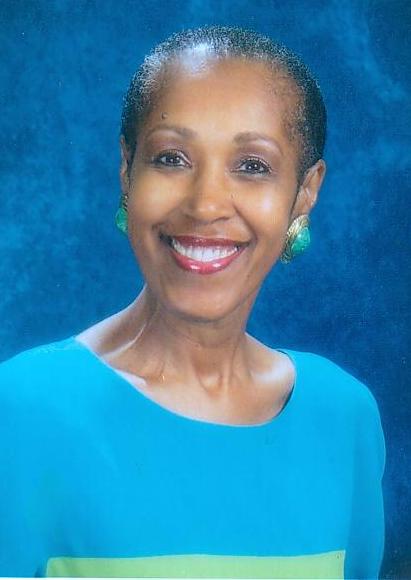 ( She's where I inherited the Supa gene)
 "You definitely come from the East," we'd hear (constantly), from those folks familiar with people on the continent. As I got older, people began to ask the same of me. Depending on how I was rocking my hair at any given moment, people would guess, Trinidad, maybe? Ethiopia, Indian (dots, not feathers)? "Nah, I'm authentic black girl. From the States," I'd assure them. But it bugged me that I didn't have more to offer. "Someone once told me I looked Fulani," was my usual reply.
"Yes, I can see that. Strong possibility. They have a very distinct look, you know," my once Nigerian love, Yinka, would often co-sign. "A Yankee girl Fulani," he'd tease. "Well. One can only guess."
Around the same time, my mom (an avid traveler) had booked an educational trip to Egypt, but was forced to cancel. The wicked breast cancer had returned, for what would be, the last time. It began to quickly spread though her body; she became too sick to travel. Less than a year later, mommy was gone.
I promised myself two things. One - I would make that trip to Egypt for her, in her honor. (which is why Dr. Smith's suggestion a few weeks back is personally significant.) Two - I would pick up where her genealogical dig had left off. Except, I wanted to now explore a different route. I wanted to start from the beginning.
Soon enough, I'd come across information about Dr. Kittles, a biologist and co-director of Molecular Genetics at the National Human Genome Center at Howard University. He started an organization, African Ancestry, which through his research, has allowed him to compile an African Lineage Database (ALD) which contains 11,747 paternal lineages and 13,690 maternal lineages from over 160 ethnic groups across the African Continent. The ALD contains DNA sequence data from individuals throughout the continent of Africa, and there is a specific concentration on regions that are known to have participated in the TransAtlantic Slave Trade.
I did my research, and felt comfortable enough to pay the fee and request a kit. Then came the consent form, the cheek swabs, and off it all went, back to the lab. The rest..well, the rest is MY history.
Weeks later when that package finally arrived at my door, I sat and stared at it. Had a few glasses of wine over it, while quietly contemplating. What would be revealed? What if my DNA type couldn't be matched? (this is a possibility, Dr. Kittles warns, although slight) What if I'm not from Africa??? (don't laugh, it can happen). What if, what if....
I finally woman-ed up; opened the package. The results? Well, it was a 99.4% match. And it said: Look to the east, black woman. Look to the east...
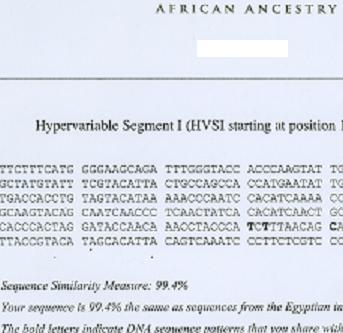
This is part of my report, my actual DNA sequence, and how my type was matched.
After years of study, I'd also learned that the Fulani were one of the most widely known group of nomads in Africa, who presently, live in communities throughout much of West Africa, from Senegal to Cameroon and as far east as Sudan and Ethiopia. It is also said that slavery and colonialism dispersed Fulani throughout the Middle East, the Americas and Europe. American history books are full of individuals of Fulani origin who have distinguished themselves in North and South America and the Caribbean.
So, perhaps that wise man from Cameroon wasn't too far off, after all.
My black history project has been such a wonderful instrument on my journey toward self. It's not the entire picture, but it gives me a valuable piece to integrate into my cultural autobiography. As a result, when I look in the mirror - now, I see so much more. Yes, I'm still the thick-haired, round the way girl who came up in Inglewood, by way of Ohio, by way of a Virginia plantation - AND, I'm a Nubian sista in the New World, distant daughter of Isis, descendant of the most original people on Earth. I now watch my daughter compose her black history reports with pride; for she now has two places, on two maps, she can point to.
(picture of a Fulani woman) (picture of me)

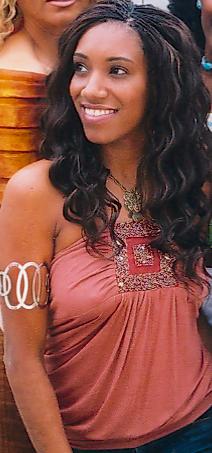 (Resemblance?)
In regard to the reparations argument for African descendants in America, I now think this is something that should be included in the prospective package: A DNA test should be offered to any black person in America who wishes to trace his or her roots. Considering our forced migration, I think this would be a positive form of restitution; a unique way to allow us to reinstate the missing parts of our past.
Until then - we can choose to start down the path on our own. For more information on how to start on your individual Black History project, visit these links:
African Ancestry
African American Lives PBS special hosted by Henry Louis Gates, Jr.
Ancestry by DNA
Roots for Real
Motherland: A Genetic Journey (program on BBC)
Be sure to check out these bloggers who have mentioned their journeys:
DNA Can Set You Free at OTV.
Tracing Our Roots at Emerging Phoenix
My DNA at Mz. Powderpink's
Happy Black History! It's not just for a month. It's fo' life.


31 comments:
Fiznurst!
Wow. I gotta take the plunge now too. From the pic you displayed I can see the East African resemblance as well. Your moms does look Queenly. You are lucky to have had her steer you on such an ambitious path. She must have some strong genes because I can see her Queenlyness in you too (wink).
Be blessed as you are.
@ DPM - Thank you! Mad props to you, luv.
@ Klingonwoman - WOW. That's an amazing feat your family accomplished. Having a country to connect to does enhance one's experience, doesn't it. Thanks for sharing!
AWW WoW SUPA!!!
This entry was soooo cool and deeeeep!
I love being able to read and feel with such clarity the depth of emotions and the significance here...
You are fabulous! I have been to S. Africa as well as a few places in the Netherlands (Holland, Amster and Rotterdam) So I could in many ways relate the PBS Special African American Lives... but reading the jouney of someone I "know" is quite different and so AMAZING!
I'll rejoice with you when you honor your mother
with your trip :)
Thanks for the shout out Supa!! I am sending my swabs off today, so I should (hopefully *fingers crossed*) get my results in 4-6 weeks. It is awesome to share in someone else's journey to their roots, and I really enjoyed sharing in yours.
Your mom is gourgeous, and her fire (and beauty) live on in you. May she rest in peace.
Wow...this is so hot!!! I can't articulate how phat it is of you to know where your roots originated. Thanks so much for sharing with us. BTW, your moms is beautiful. Seems like she raised a pretty wonderful daughter, too:) Thanks Sis.
Supa, what a beautiful tribute to your heritage and your mother. My mom's side of the family traced our heritage all the way back to the Congo. It took years of research and time, but a fully constructed family tree now exists. At a recent family gathering we discussed whether or not we thought the DNA testing was something we should partake in as a family...
my aunt, an Anthropologist in Maryland is concerned that this testing will further marginalize black people into thinking that some are less black or more black than others.
We'll see!
I am possibly interested now. I am going to have to look into this and get more info
Supa, I can always depend on you to give us some thought provoking and extremely useful information.
For Black History month, my BabyGirl was assigned a project in her SS class. The teacher told her she could choose whomever she wanted to learn more about. I was amazed that she said she wanted to do a project on herself because she loved being black and she was going to make history. Cute but impressive all the same.
Well, since we only have the month of February in school, she reluctantly selected the Black Panthers but I told her we would start researching our family tree/history together. I've been checking out various website to determine where to start, but I think I've found it. Thank you so much!
BTW, your mom is beautiful.
Peace & Blessings
Wow. Thanks so much, each of you, Blogger Fam.
I cried while writing this article/post. It's a sadness that still makes itself present in happy moments/events. I just miss my mommy!
She is/was truly my greatest example. A definite queen.
Now you guys, get your tests done, and make sure to share!
Peace.Love!
Jamal this was a beautiful post. Actually it goes beyond post, it is a nice, nice piece of work. Congratulations on this piece and on getting your results back on your DNA results.
Most importantly you were so blessed to have had such an influence in your life as my dear beautiful Sorority Sister who I regret I did not get to know. Though she did give me the gift of knowing you and the young warriors and being able to share our artists world. For that I am thankful.
Great research Ja-miz-zall and BEAUTIFUL writing. The picture captures your essence.
Peeking out from the cave for a moment to show love. Ja
O.K. Now I have homework to do! You & DPM have got me primed to dig deep. BTW - Your mama may be gone, but you must be comforted to know that someone so beautiful lives on in you. This is the reason we need to find our past - we're going to be someone's "past." Thanks for sharing the research!
a couple of years ago...wait, it was yesterday. i forget the rest of it. nice blog. nice and interesting. nice and deep. nice and thought provoking. nice pictures. nice toes. nice people. salty mood. i got my reparations. i don't know what happened to yall.
Skia. Sweetie, remember our last talk? Take your meds. Everyday. No matter how good you THINK you feel...
lol
oh yeah, thank you.
I saw that program on PBS with "Skip" Gates and it made me interested in finding out about my "pieces". I think I'll follow your lead.
Your moms was beautiful so you got it honestly. Them genes are something.
KZ
Thanks, Zeddie.
Re: Gates. I was trippin' when they were having trouble locating his African heritage. Not that there's anything funny about that, but dude was DISTRAUGHT.
Oprah had her test - She has NO European ancestry. She's like 96% African, 4% Native American..
Chris Tucker's ancestors were from Ghana, I believe. He went back there during the course of the special. Watching his journey back to the coast, walking through the slave galleys - powerful stuff...
interesting...I'm just glad BHM is over (for the public) as I live Black History everyday.
damn you Jaml! Got me crying over here! shit! I'll be back with real comments later when I regroup!
ok - exhale.
I wasn't going for the oscar with my above post, promise.
What it is is that I get so many folk do the dumbest 'Africa has nothing to do with me' bit and BELIEVE it and then those that come at me with the whole African traditions are wierd and are bullshit and the elsers ain't got shit to say that I got to a point of despair.
So reading your post today just took me THERE (the good there). I mean you got way back at 10 and all this research Jamal and then the side by side picture!! GURL!!!
I'm making no sense, I know.
Beautiful post and please go to Egypt! You mother was beautiful!!!
Laughing at you, Mwabi. Sis, it's all love. :) I knew you would be proud of me. :)
Ok I have been on a blogging break, but was told by Mwabi that I needed to get over here... and wow. Girl.....
First I want to say, I think making that trip for your mom would be an awesome way to honor her. She is absolutely beautiful. I see where you get your beauty from.
I'm happy you shared your experience. I pray that when I do it, I will get some answers. I like the idea of this test being included in our reparations. Good idea! On this Black History Project, you get an A+.
It's funny, I have the adinkra symbol of Sankofa on my key chain...thanks for the ref. and thanks for this post.
Got three things to say.
1. Girl, you know black don't crack.
2. I wanna grow up and be like you mama.
3. WOW That resemblance is uncanny and great. You've found your twin
Supa:
When I saw Sankofa I immediately felt home sick--I was a number one promoter of the concept from 1996-2001 endlessly. As you know on our radio show Sankofa Perspectives/Circle, my own segment Sankofa Seeds , and finally Sankofa Sessions on KABF 88.3 FM in Little Rock. Tying your positive past to your future is a good thing, and sifting through all the garbage of time to find the truth is invigorating to say the least. I'm happy to see you taking an extra step in that direction with the DNA comparison to all regions of Africa. It also is important for your children to have that tie not only to family they can see everyday, but also to those who have been blessed to walk with us here on earth. Keep doing positive things sister for you make me not want to sit down. I think I sat down for a few years after 2001, but I'm back on my feet again. Thanks for being there in the mix.
I did this years ago and I am still trying to sort out some of the finer meanings of this. The technology is very young still and limited. So I am awaiting all new innovations in this DNA stuff. Also, National Geographic is doing a world wide DNA databanking. Anyone can participate by going to the National Geographic page.
I am ALL late...but this is a WONDERFUL post and sounds like an exciting journey...I think being bi-racial, my ancestral quest should be interesting to say the least...
Your mother...simply beautiful...the OG SupaMomma!!
So I had gathered from all the pics I've seen of your mom over the years that you took your exotic, regal looks from her, but when I saw the pic of you and your cousin side by side, why did I think immediately of when RR#2 was on the catwalk in Jamaica holding court as naturally as if she'd been there before. And a few other things make so much sense. The pieces really do fall into place when you push them.
And what are we gon do with Askia! Toes???! lol
@ Tam: Thank you!:) OG Supamomma. Cute. :)
@ OCS - Me and my "cousin." lmao!!!
Girl, much as I love that brotha, Askia is a LOST CAUSE
Thank You for this!
You've inspired me to get in touch with who I am.
Tracing your roots must be truly a humbling and appending experience
I've been thinking about doing this too Supa.
I have a blood condition that mostly affects Mediterranean people. My doctors are baffled by it. I have a strong resemblance to people from the West Africa, particular the Ivory Coast. My hair braider always tell me I remind her of her mother and sister.
Thanks for posting this.
supa you're simply incredible. and very beautiful. no flattery or anything just the truth. I can see the Fulani angle. I'm feel proud of your journey and for once i'm lost for words. god bless sweetheart.
Dear Sis,
I am Hassan from Jos, Nigeria and I am a Fulani. You are so beautiful and really I can see strong Fulani resemblance, and your mom is a queen. If you want to know more about the Fulani, these are my email addresses: hassan_naungo@yahoo.com or abba_dasso@hotmail.com. May the Almighty 'GENO' (God)in Fulfulde/Pulaar, that is Fulani language; bless you.
Hassan
I have never posted a comment on these types of sites before... but I had to share my thoughts.
I encourage you to continue to share your gift of writing with the world. Your honesty and critical self-analysis has blessed and encouraged me to discover my history more fully.
God Bless you Forever!!
Outstanding Post!
Post a Comment